
If you’ve been around SEO and link building long enough like I have, you know that link building has transitioned through multiple different definitions. It’s also historically been conflated with lots of other tactics.
It’s been confused for link earning. It’s been confused for content marketing. It’s even been confused for the entirety of SEO.
Suffice to say, it’s none of those things. Link building works in conjunction with link earning and content marketing, and while it’s a very important aspect of SEO, it’s a discipline of its own.
Lately, I’ve noticed this happening again, this time with something new: digital PR.
And while digital PR and traditional link building certainly have plenty in common, I think we’re doing both disciplines a disservice when we treat them as interchangeable.
For example, this tweet from John Mueller lit up the SEO/digital marketing X-verse.
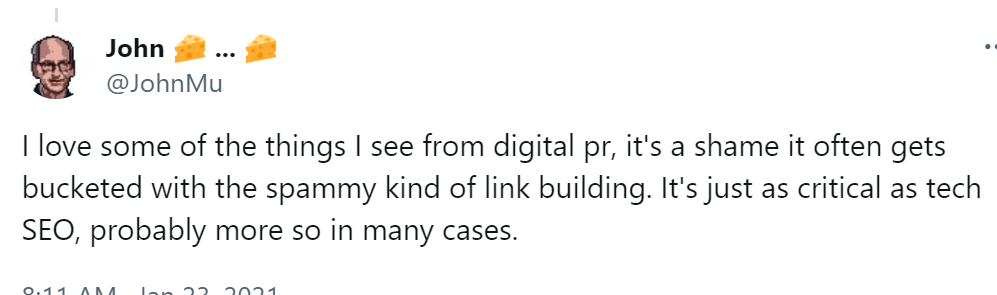
It was in response to a conversation about the boom in hiring in both the digital PR and link building sectors.
There are a few reasons this sparked such a conversation. First, pretty much anything John Mueller says is going to get disproportionately high attention. He is, after all, one of Google’s most recognizable public-facing voices.
Second, the conflation of link building and digital PR is a real thing.
And third, the inclusion of “the spammy kind of link building.”
Even before digital PR was really a thing, “spammy link building” vs “natural link building” has been a core issue of SEO. Many people don’t understand the differences. Some even think that natural link building isn’t a thing and that all link building falls under the umbrella of “spammy.”
And here’s what I find interesting. Somewhere along the way, digital PR started earning a reputation as the respectable way to build links, while traditional link building was increasingly viewed with suspicion.
But does a backlink suddenly become more valuable simply because it came from a digital PR campaign? And is a carefully earned editorial link somehow less legitimate because someone went out and specifically asked for it?
I’m not so sure.
I’d like to explore where digital PR and traditional link building overlap, where they differ, and why I think the distinction matters.
Because at the end of the day, shouldn’t we be more concerned with the quality of the links we’re earning than what we happen to call the process?
Are Link Building and Digital PR the Same?
Perhaps you’re not an expert in regards to digital marketing and SEO, but you know a little bit about marketing in general.
Did the white hat link building process I describe sound that different from public relations to you?
If you said no, I don’t blame you for that. There are several commonalities.
In the most general sense of white hat link building that I laid out, a lot of it is proactively expressing the value of your brand to people you want attention from. While that’s not the totality of public relations, that is a substantial portion of it.
So, for the most part, I believe it boils down to semantics.
That said, I think it’s more correct to say that white hat link building and digital PR greatly overlap, more than saying they are essentially the same.
I suppose one difference is that digital PR tends to focus more on getting attention from journalists and media outlets, whereas traditional link builders are happy to get a link from just about anyone, provided the website is relevant and the link makes sense.
A librarian, a blogger, an industry association, we’re not particularly picky about job titles!
Here’s how I see the main differences between the two.
| Digital PR | Traditional Link Building | |
|---|---|---|
| Main goal | Media exposure, brand awareness, and backlinks | Relevant, authoritative backlinks |
| Typical targets | Journalists, newspapers, magazines, news websites | Blogs, industry websites, resource pages, associations |
| Content | Newsworthy stories, surveys, research, and data | Useful resources, existing content, and linkable assets |
| Outreach | Pitching stories to journalists and editors | Reaching out to relevant website owners and editors |
| Biggest advantage | Potential for widespread media coverage | More targeted, niche-specific opportunities |
| Biggest challenge | Unpredictable coverage and duplicate syndication | Time-consuming research and personalized outreach |
| Success | Quality coverage, brand exposure, and links | Relevant editorial links and qualified traffic |
Black Hat vs. White Hat
Let me start by explaining what constitutes “spammy” link building, and why it needs to be separated from normal link building.
Spammy link building is best classified as “black hat.” Black hat is a designation for tactics that are specifically meant to manipulate Google’s algorithm in a way that in no way improves user experience.
Have you ever come across a roughly 500-word article that featured everything from broken English to a link within the content that was shoehorned in? What you saw was an example of black hat SEO.

Google not only discourages practices such as these, often they will outright penalize sites that engage in these tactics. Their algorithms may not detect these schemes immediately, but they get faster year after year, sometimes month after month.
White hat is, well, the opposite of this style of link building. White hat link builders seek to build links that are relevant and that improve the overall experience of the internet.
As with black hat link building, there are a variety of tactics at the disposal of a white hat link builder. There’s resource link building, broken link building, etc.
But at the heart of each tactic comes one particular aspect: earnestly and in good faith explaining the value of your site to another person, and getting that person to link to you as a result.
And here’s what I find a little strange. If a digital PR agency reaches out to a journalist and convinces them to write about a brand, everyone applauds. But if a link builder reaches out to a webmaster and convinces them to link to a useful resource, suddenly we’re talking about manipulating Google? I’m not sure I see the difference.
Let’s say that you run a site for a brand that designs/sells clothing. You want people to link to your site, but you don’t want to employ black hat tactics. What you would do is compile a list of influential, authoritative sites within the fashion niche. After that, you would build relationships with these sites over time. While building these relationships, you would represent and explain the value of your brand and why it may be valuable to that site’s users.
Once those relationships have been built, you would ask these sites to link to you.
To be fair, this is an incredibly simplified breakdown of the white hat link building process, and as with anything, there are a whole host of nuances once you go beyond the surface.
But this is link building the white hat way, at least in Google’s eyes.
Digital PR and the Dream of Going Viral
To me, digital PR represents more than asking for links.
A lot of digital PR revolves around creating a very shiny and cool piece of content primarily for the purpose of gaining media attention and consequently links. There is also an aspect of ‘bragging rights’ if that is something you feel is valuable for your brand.
After the content is created, a digital PR team will start promoting it to various online journalists and news sources. In return, those online news sources will link to them as a means of attribution.
I sense that when it comes to ‘digital PR’ there is a certain level of hope/expectation the content will ‘go viral’ and get picked up by big media outlets, which is really not something on the radar for link builders.

Sure, there’s no question that having linkable content at your disposal is highly valuable and many times necessary for any link building campaign.
But, a link building team is usually more focused on creating linkable assets for the sole purposes of securing relevant links even if the content doesn’t become the talk of the town. We’re a more humble bunch, if you will ?
If I can build an editorial link on a well-curated authority resource page run by a librarian or professor I consider that a home run.
Whereas a home run for the digital PR team may look more like being featured in Time magazine. Something else to keep in mind is that although the prospect of such a feature is indeed very enticing, I’d venture to say that it’s not very common at all for a digital PR team to hit such a home run. I don’t have data to back up what I’m saying but it’s just a hunch based on the hundreds of digital PR pieces I’ve seen over the years.
Another thing I’ve noticed with some digital PR campaigns is that the same story gets picked up and syndicated across dozens of websites, sometimes practically word for word. Sure, the backlink report looks fantastic, but how much additional value are you really getting when 30 websites are essentially publishing the same article?
At that point, it starts to remind me more of a press release distribution service than genuine editorial coverage. I’m not saying those links are worthless, but I’d certainly take 10 independently earned, relevant editorial links over 30 copies of the same story.
The truth is sometimes, content is not necessary for link building at all. There are several methods of link building that involve little to no content. You can still try to build links on authoritative directory sites, search for unlinked brand mentions, broken links, and many more perfectly legitimate links.
In link building, you’re looking for any relevant, authoritative site that will link to you for any natural reason.
Whereas with digital PR, you’re mostly targeting news/magazine sites.
Passive Link Building
Another possible distinction is that ‘digital PR’ may have the connotation to some that your content will yield passive links, with little to no outreach.
As I said in the introduction, a lot of people conflate link building and link earning: I’m not one of those people. They are two distinct categories to me.
Link earning is essentially the idea of creating content/resources that are so valuable and telling a story of your brand that is so powerful that relevant people within your niche will want to link to you without you having to necessarily ask.
While link earning is an ideal scenario, it’s also not a very plausible scenario, at least for the majority of sites.
So if someone is trying to sell you a passive link building myth, don’t say I didn’t warn you.
The reason why it’s not so plausible is that if your site ranks low for your target keywords and you don’t have a host of quality, relevant backlinks pointing to your site to begin with, linkers will have a hard time naturally finding you.
It’s a bit of a chicken-and-egg problem. You need links to get noticed, but you need to get noticed to earn links. And unless you’re already a household name, sitting around waiting for people to discover your brilliant content isn’t much of a link building strategy.
Ultimately, there are a lot of processes that go into the promotion and marketing of a website. It’s easy to get confused about who does what and why, and which are the more valuable strategies
But there’s a common thread that can be found in strategies like digital PR and natural link building: expressing the unique value proposition of your brand/site for the greater good of users.
And at the end of the day, I don’t particularly care whether someone calls it digital PR, traditional link building, or something else entirely. If a real person running a real website sees value in what you’re offering and decides it’s worth linking to, that’s a win in my book. No fancy label required.
Comments
Hi David,
It’s an interesting and great informative article on digital pr and link building. I Loved it, and I would like to see more and more content like this in your future posts. Keep it up.
Thanks,
For sharing this article with us.
Great insights on the differences between link building and digital PR! It’s refreshing to see common myths addressed so clearly. Understanding how each strategy serves a different purpose is crucial for effective online marketing. Thanks for shedding light on this important topic!”