
- Link Signals Still Carry Real Weight, But Vary
- Why the 8% Number Undersells What Links Do for Maps
- Link Signals Have Been Losing Ground for Years
- Quality Beats Volume in Local Link Building
- What Makes a Single Link Worth Pursuing
- Citations Matter More for AI Than They Do for Google
- Building Citations in the Right Order
- Dedicated Location Pages Deserve Their Own Links
- NAP Consistency Is a Customer Signal, Not a Ranking One
- Where to Focus Your Local Link Building
The biggest link building myth refuses to die.
Here’s the honest truth most link building agencies won’t tell you: a single relevant link will outperform fifty irrelevant ones.
Google doesn’t count links anymore, it judges them. Context, authority, and relevance decide whether a link actually moves the needle, or just sits there doing nothing for your rankings.
If you’re serious about Local SEO, go local with your links. Look for opportunities tied to your city, your neighborhood, your region.
Don’t ignore industry-specific links, either. A link from a site that lives and breathes your industry tells Google (and real users) that you’re not just present, you’re relevant.
These links carry weight that generic directories simply can’t match.
But here’s the part that changes everything – how you build links today looks nothing like it did a few years ago.
The old playbook, mass outreach, paid placements, link farms, doesn’t just underperform anymore. It can actively hurt you.
So what actually works now? Let’s break it down.
Link Signals Still Carry Real Weight, But Vary
Whitespark’s 2026 Local Search Ranking Factors survey asked 47 top Local SEOs what factors they consider most important for Local SEO.
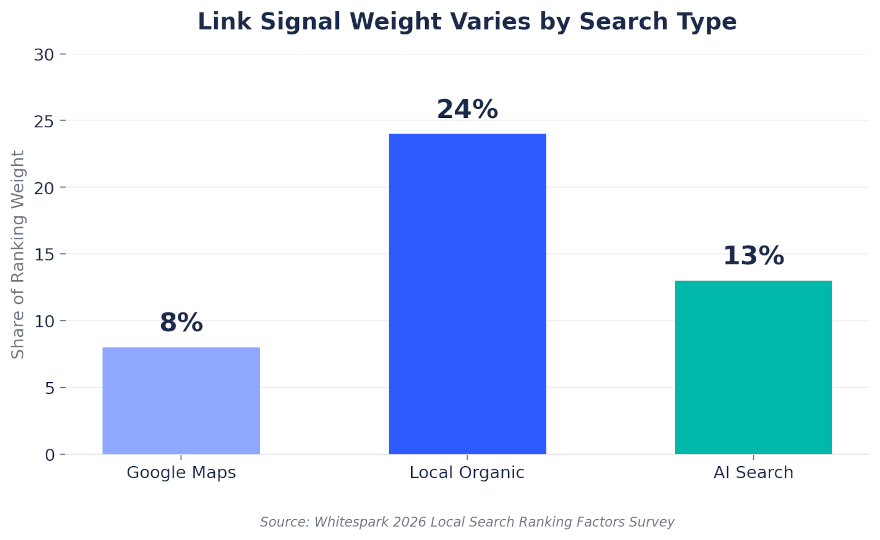
Regarding link signals, the survey showed importance varies by what kind of local rankings:
- 8% for Google Maps
- 24% for local organic
- 13% for AI search
Keep all three in mind when building your links. Whenever possible, full brand mentions with context are best.
Read The Link Building Signal AI Search Engines Care About Most for why.
Why the 8% Number Undersells What Links Do for Maps
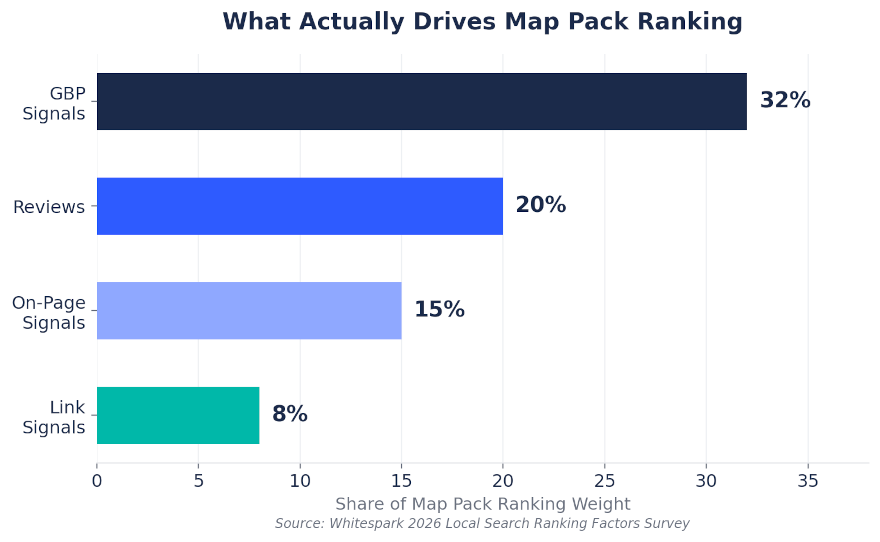
Link signals inside the Google Map Pack category account for only about 8% of ranking weight directly, well behind Google Business Profile (GBP) signals at 32% and reviews at 16 to 20%. That number is misleading on its own, though.
Google has stated plainly that your position in organic web results is also a factor in your Map Pack ranking.
Prominence, one of the three pillars Google names for local ranking, is built from your website strength, reviews, citations, backlinks, and broader online reputation.
The links that build your 24% organic authority don’t stop working once they’ve done that job. They carry over into how prominent Google considers your business to be on Maps too.
Link building isn’t a direct Maps lever the way GBP optimization is, but it’s not irrelevant either. It’s indirect, and it compounds.
Link Signals Have Been Losing Ground for Years
This isn’t a one-year shift. Link signals have been on a steady decline across multiple editions of local ranking studies. It used to be that getting lots of links was considered the key to SEO. These days, that’s changed.
Part of the reason surfaced during the Department of Justice’s antitrust trial against Google, where internal details revealed just how much weight the company puts on behavioral signals.
Do searchers click a result and stick around, or do they bounce back to search again?
As reliance on those signals grows, link signals shrink in relative importance, not because links stopped working, but because Google leans more on other signals.
Behavioral engagement and consistently receiving new reviews are more important. No amount of link volume makes up for weak signals in those areas.
Quality Beats Volume in Local Link Building
A handful of links from sources tied to your actual community will do more for organic rankings than a stack of generic directory links ever will.
Local news coverage carries topical and geographic relevance that a national directory can’t fake. So does a Chamber of Commerce listing.
A sponsorship mention from a community organization works too. Ten links like these will outperform two hundred links from sites with no connection to your city or your industry.
What Makes a Single Link Worth Pursuing
Not every local link has the same value and the metrics commonly used are not as useful as actual traffic. Having real readers is a better indicator than Domain Authority or Domain Rating because those scores can be inflated or gamed.
Two questions matter: is this a real website with quality content, not an AI-generated site built on an expired domain to sell links? And does the site focus on your industry?
A link doesn’t need constant traffic to be worthwhile either. For example, a regional trade association site that gets modest visitors year-round but has solid standing in your industry is worth pursuing, even if there’s a placement fee involved.
Having both topical and local relevance together is even better. A landscaper picking up a mention from a local nursery, or a dentist getting linked from a nearby orthodontist’s referral page, combines both.
That kind of link, tied to both your city and your industry, is worth more than either factor alone.
Citations Matter More for AI Than They Do for Google
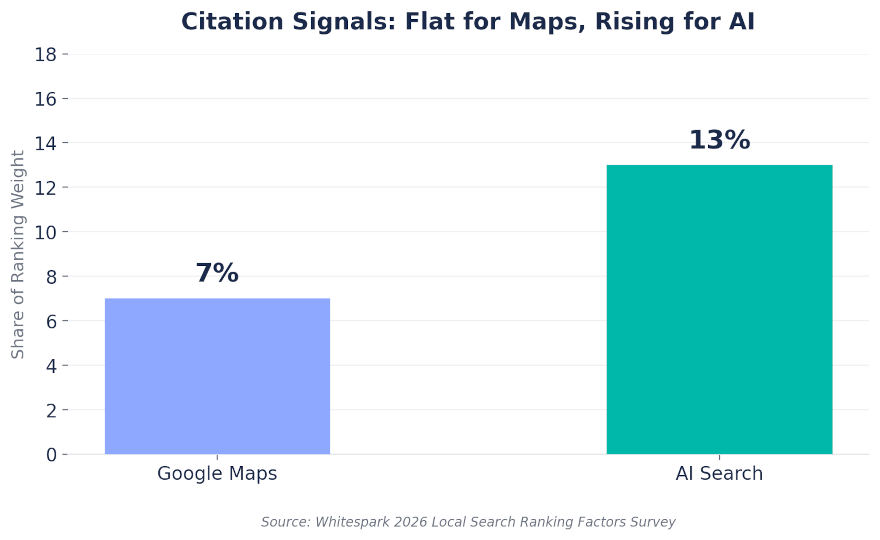
Citation signals stayed roughly flat for Map Pack rankings in the 2026 survey, but they became one of the standout factors for AI search visibility, jumping to 13%.
Large language models (LLMs) lean heavily on the broader web to judge how prominent a business is. That means being listed and reviewed on social media sites like Facebook or LinkedIn.
Have a listing with your local Better Business Bureau. Also claim whatever directories are prominent in your industry. Citations are quietly becoming foundational again, just for a different reason than they used to be.
Keep your testimonials page on your own website updated. AI picks up on that content and can cite it directly when recommending businesses.
Building Citations in the Right Order
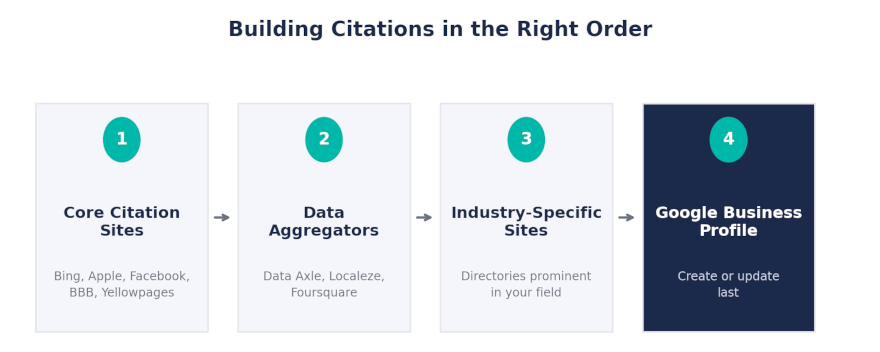
There’s a sequence that tends to work best, whether you’re setting up a new profile or expanding to a new location. Start with the core citation sites: Bing, Apple, Facebook, the Better Business Bureau, and Yellowpages.
After those, work on the major data aggregators. Data Axle and Localeze are the two most important in the US. Foursquare is worth adding too.
Next come industry-specific sites, the obvious prominent ones for your field plus any others you can find. Only after those are in place should you create or update the Google Business Profile.
If you’re moving a business address, updating Google first is the common mistake. Google checks your website and citations to confirm the new address before trusting it, so update your site and citations first, give it a week or two to get indexed, and only then update Google.
The same logic applies to opening a new franchise location: build the citations first, wait for them to get picked up, then create the new profile.
Dedicated Location Pages Deserve Their Own Links
If your business serves multiple areas, don’t route every internal and external link back to your homepage by default. Each location deserves its own page, with genuinely differentiated content, not a template with the city name swapped out.
Duplicate structure across location pages tends to trigger the same problems duplicate content does anywhere else, and search engines have gotten good at spotting it.
Use descriptive anchor text. A link that says “Boulder roof repair” tells search engines something a generic “click here” or “learn more” never will.
The same logic applies internally: link to each location page from your homepage. Consider creating location-specific service pages for at least your primary services and locations.
Link to location pages from any blog content that mentions that market using anchor text that names both the service and the city.
Structure counts too. A hub-and-spoke setup, where a main locations page links out to every city page and each city page links back, gives search engines a clear map of how your locations relate to each other.
For businesses with many nearby locations, a hierarchical structure (state page linking to city pages, or metro page linking to neighborhood pages) keeps things organized as you grow. Do not just dump every location into one flat list.
The content on each page should hold up on its own and include:
- Real details about that location
- Staff and service area nuances
- Local case studies
- Reviews specific to that market
These provide concrete information to search engines and AI models alike. Thin, interchangeable pages read as exactly what they are, and both traditional rankings and AI-driven recommendations increasingly penalize that shortcut.
NAP Consistency Is a Customer Signal, Not a Ranking One
NAP (name, address, phone number) consistency isn’t considered a ranking factor by this study. It needs to be accurate for humans, so customers get the right information when they find you. However, the SEOs surveyed do not believe small inconsistencies on low-traffic sites are likely to cause ranking issues.
Google will equate common abbreviations used in addresses such as street vs st. and avenue vs ave. The way call tracking phone numbers are typically displayed on websites should not cause mismatches.
Consistency is important on the major platforms and the industry-specific sites your customers are actually visiting. Obsessive cleanup across every citation you can find is not necessary.
Where to Focus Your Local Link Building
The best places to acquire links from sites related to your location are:
- Chamber of Commerce membership pages
- Community blogs and local news outlets
- Sponsorships of local sports teams or community events
- Offering to write op-eds or opinion pieces for local outlets
- Related local businesses in complementary industries
- Speaking engagements at local events, which often lead to a website mention or social share
Links from sites tied to your actual community or industry outperform generic directory links, and they carry weight across all three surfaces: Maps indirectly, organic directly, and AI search through citation-style recognition.
Build for relevance first. The volume will follow, and so will the rankings.
Comments